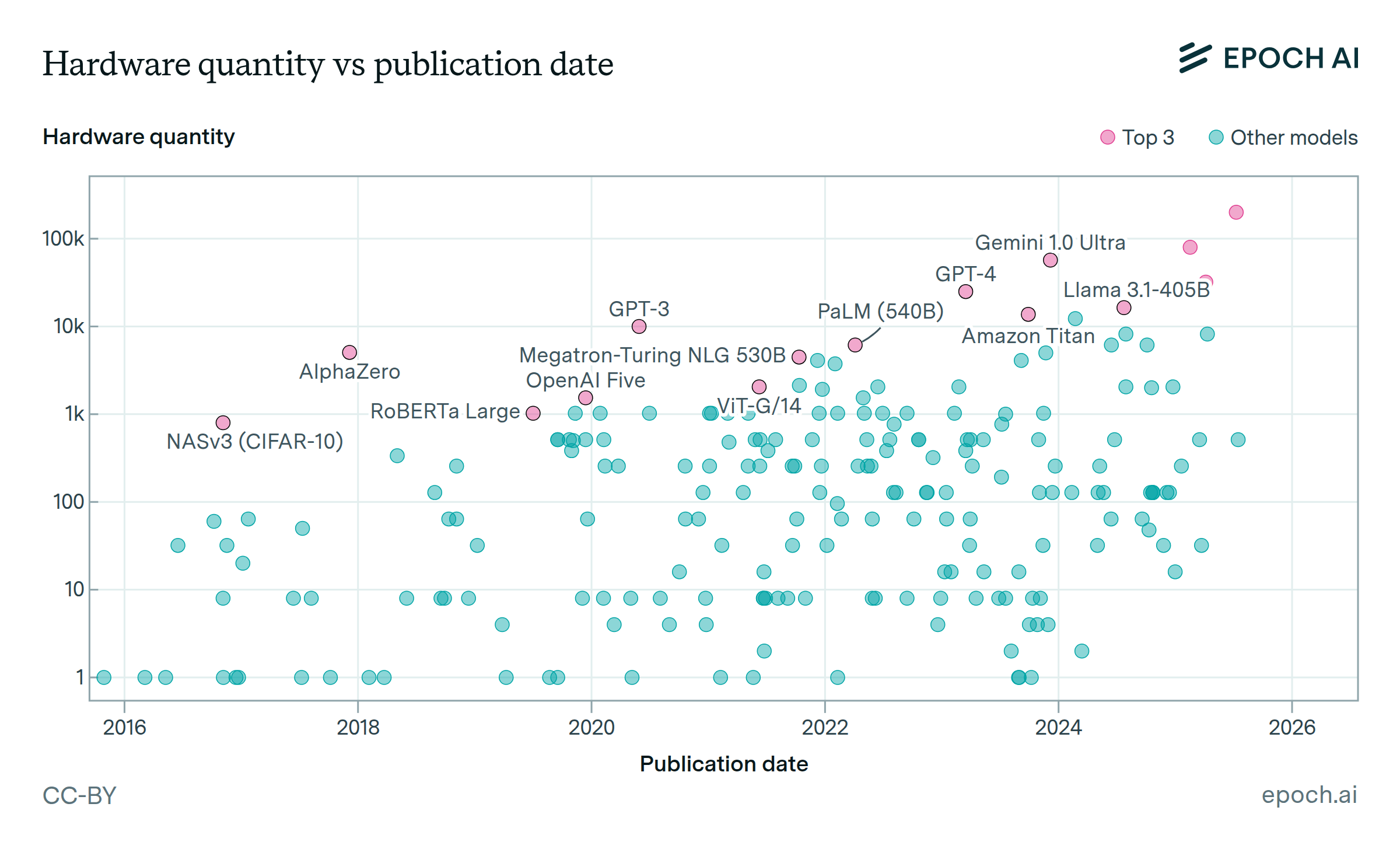
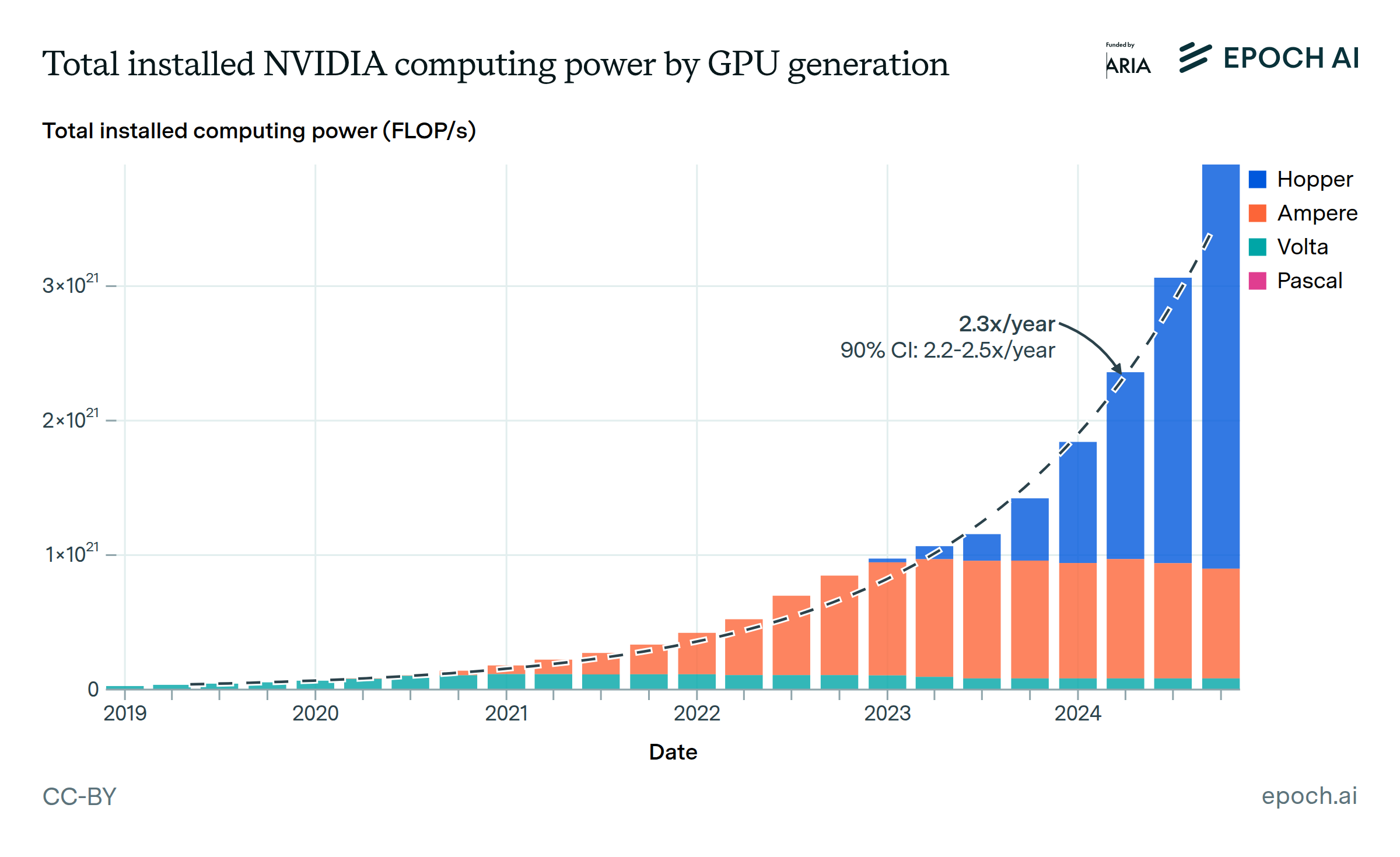
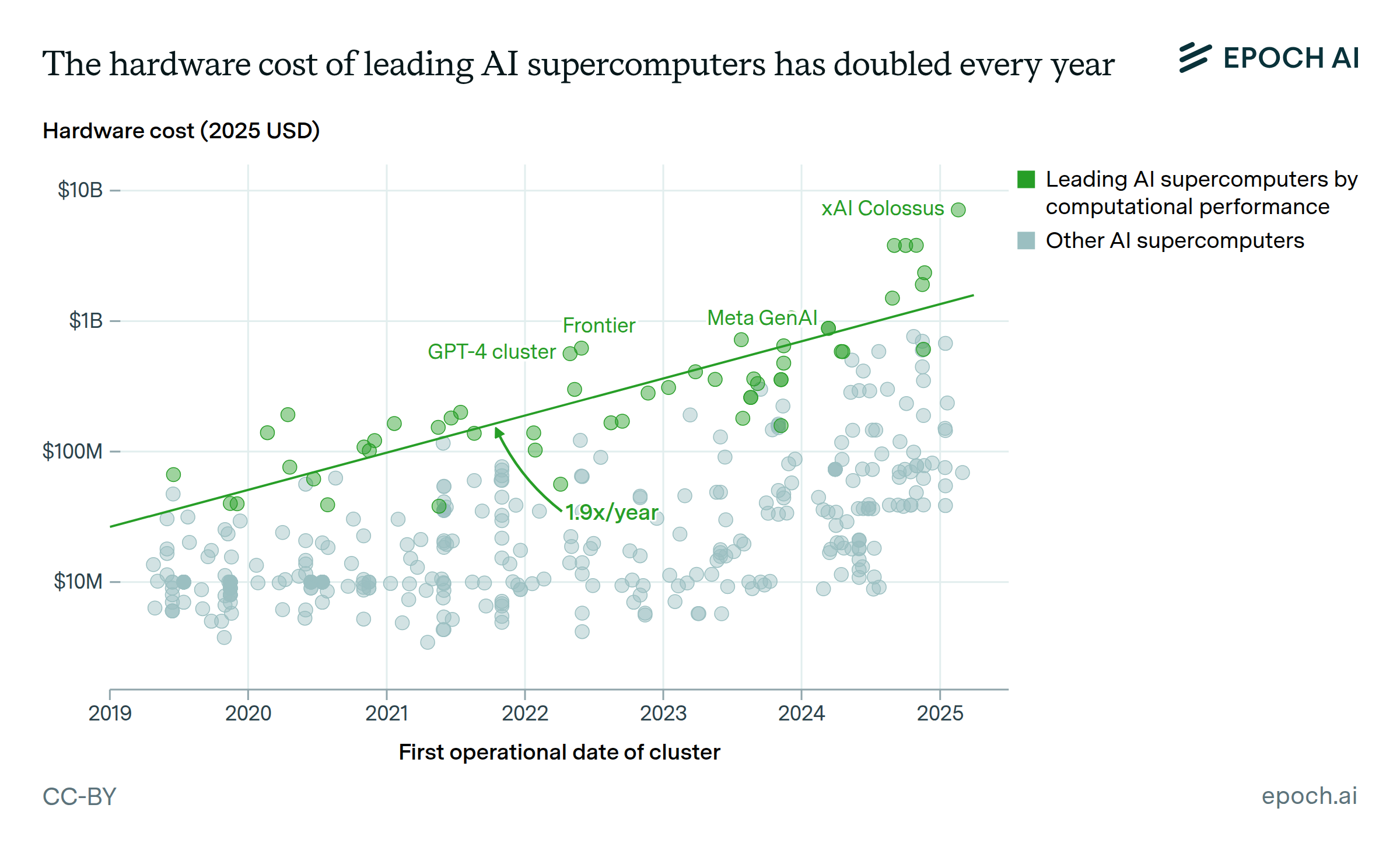
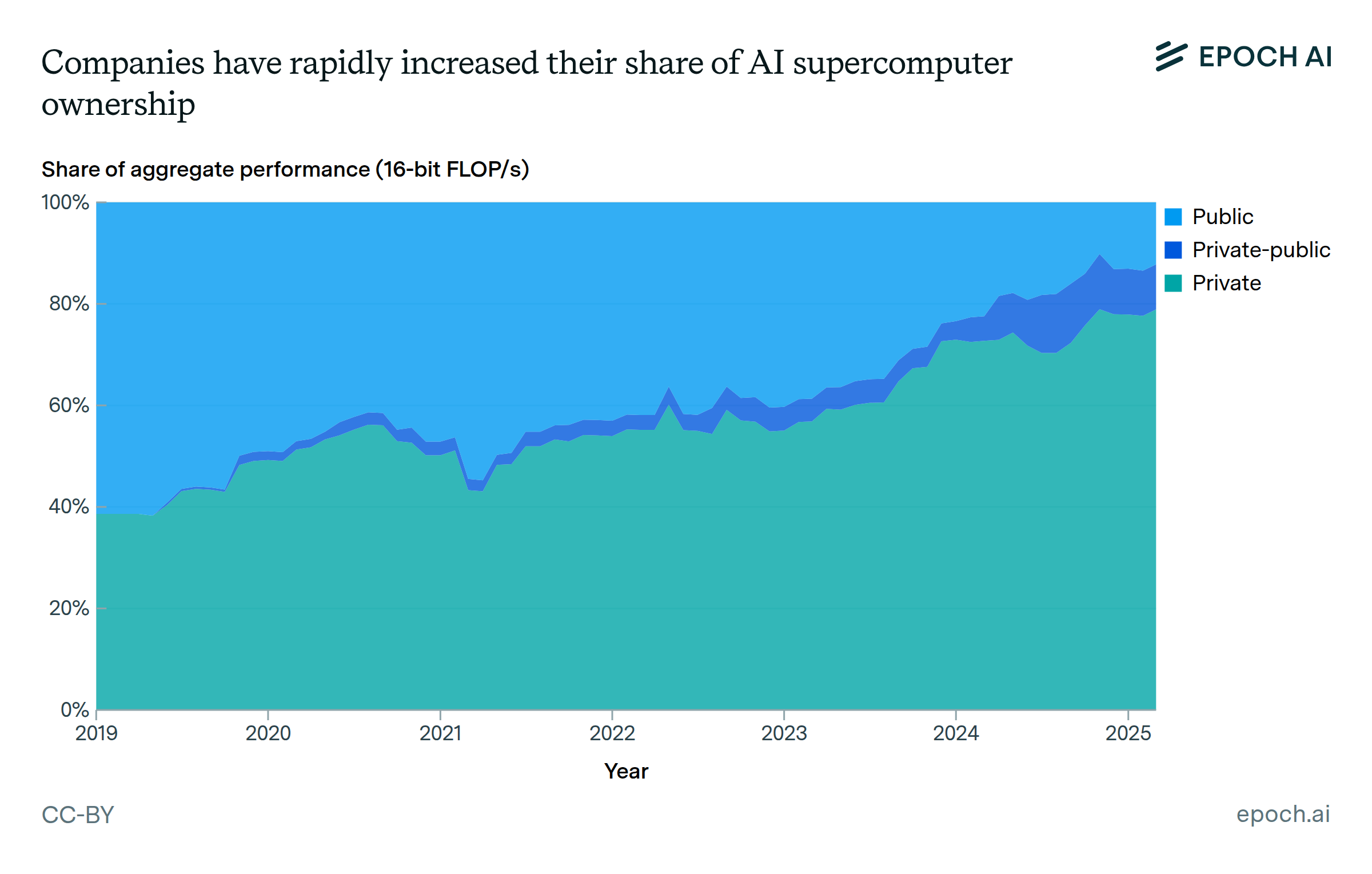
The private sector’s share of global AI computing capacity has grown from 40% in 2019 to 80% in 2025. Though many leading early supercomputers such as Summit were run by government and academic labs, the total installed computing power of public-sector clusters has only increased at 1.8x per year, rapidly outpaced by private-sector clusters, whose total computing power has grown at 2.7x per year. The rising economic importance of AI has spurred the private sector to build more and faster clusters for training and inference.
As of May 2025, the largest known public AI supercomputer, Lawrence Livermore’s El Capitan, achieves less than a quarter of the computational performance of the largest known industry cluster, xAI’s Colossus.
Epoch's work is free to use, distribute, and reproduce provided the source and authors are credited under the Creative Commons BY license.
Learn more about this graph
Data come from our GPU Clusters dataset, which collects information on 728 clusters with dedicated AI accelerators, spanning from 2010 to the present. We estimate that these clusters represent approximately 10-20% (by performance) of all AI chips produced before 2025.
We categorize clusters as public if they were built by academic or government institutions, private if they were built by for-profit companies, and public-private if both types of organizations were involved, or if a government contributed at least 25% of funding to a private project.
For more information about the data, see Pilz et. al., 2025, which describes the clusters dataset and analyzes key trends, and the dataset documentation.
Analysis
Assumptions and limitations
Explore this data

Over 500 GPU clusters and supercomputers, including those used for AI training and inference.