High-bandwidth memory (HBM) is a critical component of AI chips that provides the storage and throughput needed to efficiently train and serve large models. Total HBM bandwidth is thus a rough proxy for the world’s total capacity to serve AI models. In 2025, AI chips consumed over 90% of the HBM industry’s output in terms of revenue.
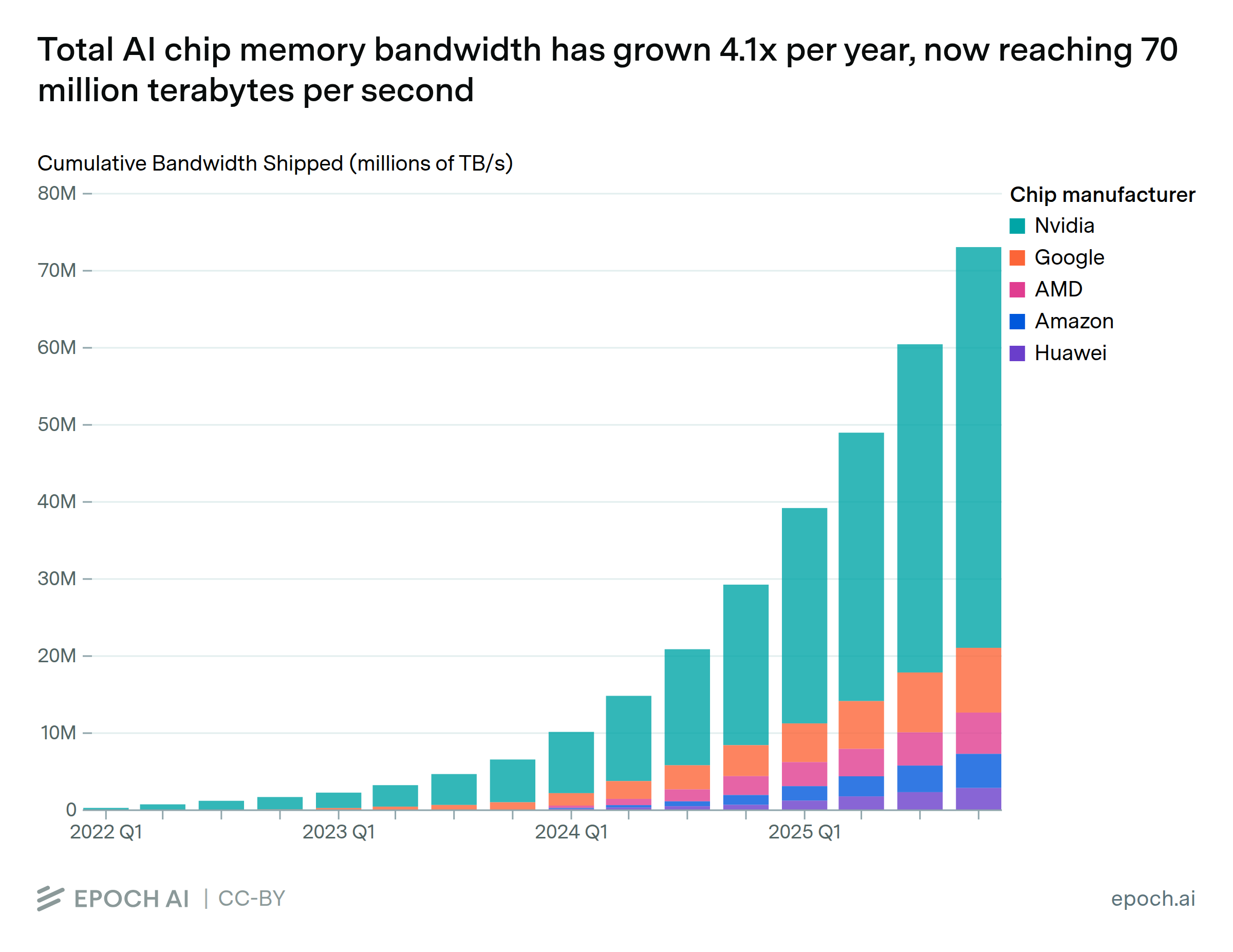
As of Q4 2025, the cumulative memory bandwidth of AI chips shipped since 2022 has reached roughly 70 million terabytes per second — around 300,000x more data per second than global internet traffic. We draw figures from financial disclosures from five major chip manufacturers.
Epoch's work is free to use, distribute, and reproduce provided the source and authors are credited under the Creative Commons BY license.
Learn more about this graph
We estimate total HBM bandwidth shipped with AI chips over time by multiplying quarterly shipments by each chip’s known memory bandwidth. When chips come in variants with different bandwidth specifications, we use the most popular variant, or take the geometric mean of all variants if we cannot determine which chip dominated sales.
The main challenge is NVIDIA’s Hopper generation, where financial reporting bundles H100 and H200 shipments even though the two have different memory specifications. We model the transition between the two using a logistic S-curve anchored to six public data points, with uncertainty propagated via Monte Carlo simulation.
Data
Analysis
Limitations
Explore this data

AI chip sales data.