AI companies guard their strategies closely. Their hiring pages, however, are public.
And those posts contain clues about what products a company is developing, who it hopes to sell them to, and which bottlenecks it sees coming. A posting for a “Camera ISP Software Engineer” suggests a device with a camera. A search for “Forward Deployed Engineers” hints at the challenges of deploying AI inside companies. A cluster of roles mentioning robotics implies ambitions well beyond chatbots.
We analyzed open roles at the leading foundation labs, including OpenAI, Anthropic, xAI and Google DeepMind1. Here is what we found:
- First, sales and sales-related hiring has increased sharply at both Anthropic and OpenAI over the past year. Anthropic’s go-to-market share of open roles grew from 17% to 31% and OpenAI’s from 18% to 28%. This increase has been particularly concentrated in technical roles that help clients deploy AI to their companies.
- Second, open roles can provide insight into the product roadmap at the labs. For example, OpenAI and DeepMind are both investing in hardware products, such as robotics and consumer devices. In contrast, Anthropic appears to be focusing on improvements to its core products instead.
- Third, career pages can help give insight into how the leading AI companies are using different strategies to acquire key inputs such as compute or data. For example, OpenAI has 21 open roles related to custom silicon, while Anthropic, which does not have an internal effort aimed at developing its own chips, has none.
A few caveats before we dive in. Job postings tell us about roles a company is trying to fill, not about its current staff. For example, a team with 20 open roles could be large and growing, or a brand-new team that doesn’t exist yet. We also can’t tell how many people will be hired for each posting: a single “Research Engineer” listing might yield one hire or ten or never get filled.

Go-to-market is the top hiring category at OpenAI and Anthropic
Sales and sales-related hiring has increased sharply at both Anthropic and at OpenAI over the past year: Anthropic’s share of open roles dedicated to go-to-market grew from 17% to 31%, while OpenAI’s grew from 18% to 28%. Perhaps unsurprisingly for companies with rapidly increasing revenue competing over a largely untapped market, sales-related roles now represent the largest category of open roles at both companies. Research, by comparison, now makes up only 12% of open roles at Anthropic and only 7% at OpenAI.
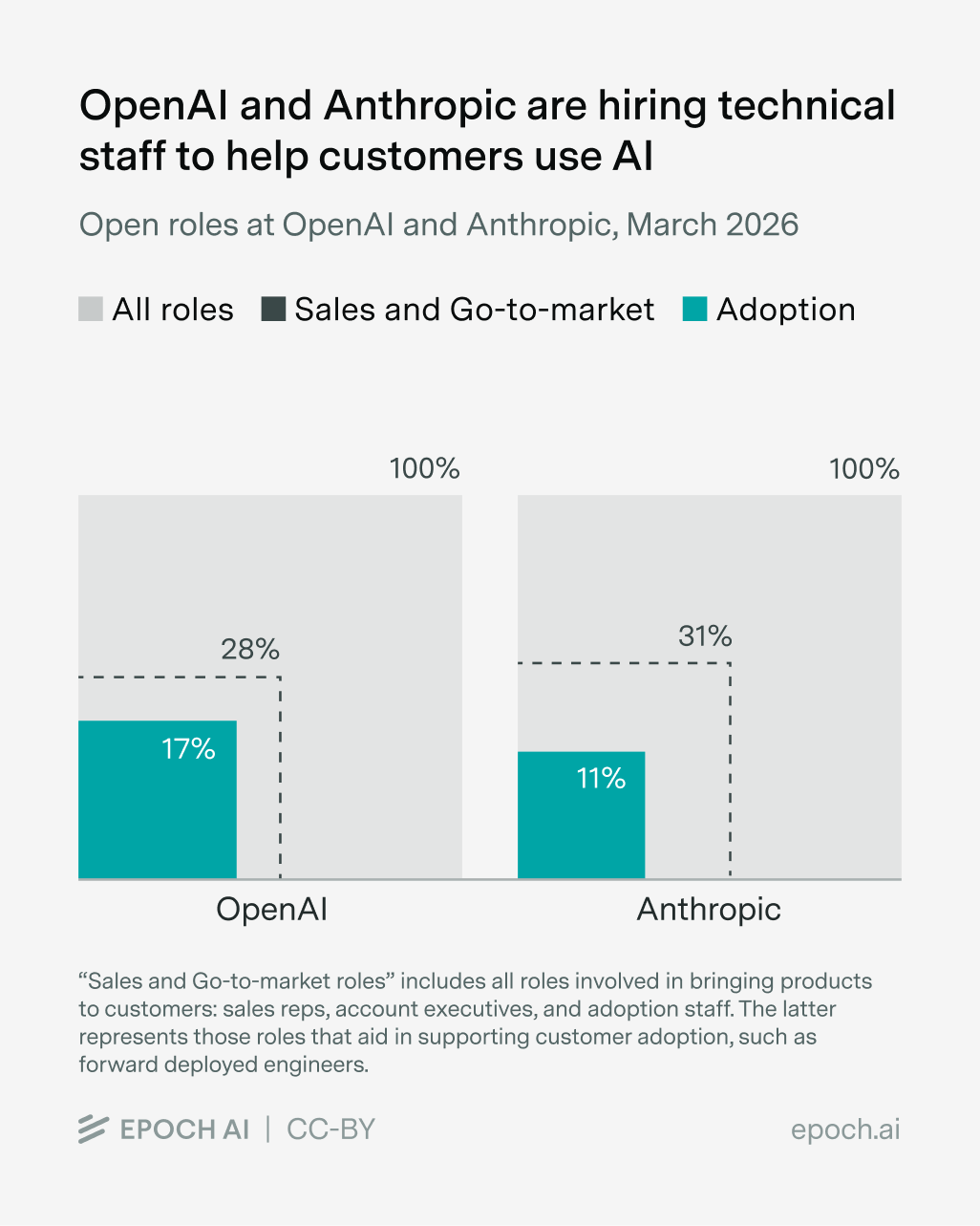
One subcategory has grown especially fast: technical roles dedicated to helping customers actually adopt AI. Both companies are now hiring roles such as AI Success Engineers, Partner AI Deployment Engineers, Solutions Architects and Forward Deployed Engineers, designed to help customers find opportunities to use AI and integrate it into their businesses. Over the past year, the share of open roles dedicated to adoption increased from 5% to 11% at Anthropic and from 11% to 17% at OpenAI. This suggests customers are struggling to fully utilize OpenAI and Anthropic’s products, and an important aspect of bridging this gap is to educate customers on what is possible.
The geographic distribution of sales roles also tells us something about where these companies see their market. More than half of each company’s sales roles are located in the U.S. with 52% of open roles at Anthropic and 55% at OpenAI. Neither company discloses its geographic revenue split, but the hiring concentration suggests the U.S. remains the primary market for both Anthropic and OpenAI by a wide margin.
Internationally, both companies are hiring aggressively across Europe and Asia-Pacific. Anthropic tilts more toward Europe, where 29% of its open sales roles are located versus 21% for OpenAI. OpenAI tilts more toward Asia-Pacific, at 24% versus Anthropic’s 19%. Within Asia-Pacific, the growth is concentrated in Japan, South Korea, India, Singapore, and Australia. Notably absent are China, the Middle East, Latin America, and Africa. The labs’ focus on global sales suggests that they do not expect to be crowded out of the European and Asia-Pacific markets by national champions.
Government sales appear to be another important priority. OpenAI and Anthropic both have 10 sales roles covering federal civilian, defense, and state and local government. Of these roles, 1 of OpenAI’s roles specifically targets national security and 2 of Anthropic’s roles specifically target national security. xAI has 2 open sales roles targeting international governments, located in London and Dubai, and 1 open role targeting the US government. These roles demonstrate the importance of government as a future revenue stream for the foundation labs.
Unlike Anthropic, OpenAI and xAI, where open sales roles can give insight into the current go-to-market priorities of the AI labs, DeepMind’s job ads reveal little about their sales motion at all, since Google’s existing sales organization handles distribution for Gemini.
Job postings shed light on new product bets at OpenAI and DeepMind
Open roles can also offer a window into what each lab is building. Anthropic has 5 open product and engineering roles aimed at improving Claude Code, while OpenAI has 10 similar roles aimed at improving Codex. Both OpenAI and Anthropic each have an engineering role dedicated to building product add-ons for financial services. OpenAI also has 3 roles targeting new features for ChatGPT Health and OpenAI for Healthcare.
That said, the view from job postings is imperfect for existing products. It can be hard to tell whether a role is expanding an existing feature or building something new, and platform or infrastructure roles often span multiple products. Therefore, job postings are most informative when they reveal new bets.
First, OpenAI’s postings show it is investing heavily in a consumer hardware device, with 15 open roles for the project. The postings reveal a fair amount about what the device looks like: a Camera ISP Software Engineer role describes building imaging systems for a battery-powered portable device, a Research Engineer role focuses on running transformer models directly on the device, and an Operating Systems Engineer role references custom silicon. Taken together, these roles suggest something like a portable device equipped with a camera, running its own AI chip, and designed to run AI models on the edge. Moreover, two Singapore-based hardware and operations hires suggest a move toward manufacturing. DeepMind is also making a hardware bet, with two open roles for the development of XR glasses, one of which suggests voice commands will be a key interaction mode.
Second, both OpenAI and DeepMind are betting on robotics. OpenAI has seven robotics roles that indicate work on training robots in simulation at scale and improving simulation realism. The postings also suggest some robots may have soft components or coverings, and that production is scaling up. DeepMind is hiring 9 roles dedicated to its robotics program, which suggest that they are building a humanoid robot, with dexterous hands.
Beyond hardware, OpenAI has 2 incubation-stage roles focused on social products, and one for a jobs platform designed to help people train, certify their skills, and get matched with employers. Anthropic has a general research product manager role dedicated to creating entirely new product categories, and another aimed at developing new consumer products.
Job postings also offer clues about how labs secure compute and data
Open roles at the labs also give insight into how each company approaches its raw inputs: compute and data. The clearest divide is between labs that are building their own compute infrastructure and labs that are contracting for it.
OpenAI has 21 open roles, mostly engineering, associated with its internal chip development effort, which represents 3% of current listed roles. Anthropic, which is not developing its own custom silicon, has taken a different path: it has multiple roles focused on overseeing datacenter design and construction with external partners, including a Data Center Mechanical Engineer responsible for directing cooling and mechanical system design produced by external firms, and a Data Center Design Execution Lead who owns the bridge between Anthropic’s technical requirements and third-party delivery partners. Anthropic also has 3 open legal roles dedicated to negotiating datacenter, or colocation contracts.
Another input that features prominently in hiring is RL training environments. Anthropic has multiple roles focused on building environments for training models on new capabilities, including an Environment Scaling team that builds RL environments and manages vendor relationships, and a Universes team building ultra-realistic long-horizon settings for agentic training. OpenAI is also hiring researchers for a Synthetic RL team developing RL training methods using self-play, simulators, and synthetic feedback.
In contrast to OpenAI, Anthropic and DeepMind, which do not have dedicated human labeler roles, xAI’s hiring suggests a distinct model with respect to human data. It has 27 open human data roles, which suggests that it prefers keeping its data labeling operations in-house. It’s also notable that xAI is comfortable advertising these roles publicly. Other labs also rely on human labeling at scale, but tend to outsource it or keep the hiring less visible.
Conclusion
Job postings are an imperfect signal, but they’re one of the few public windows into how the leading AI labs are evolving. The picture they paint right now is of companies that are investing heavily in selling and deploying their products, diversifying into new product categories, and competing for key inputs like compute and data. As the labs continue to grow and their strategies diverge, their career pages will remain one of the best places to watch it happen.
Thanks to Lynette Bye for helpful comments and editing.
Notes
-
We collected this data in early March 2026.

About the authors