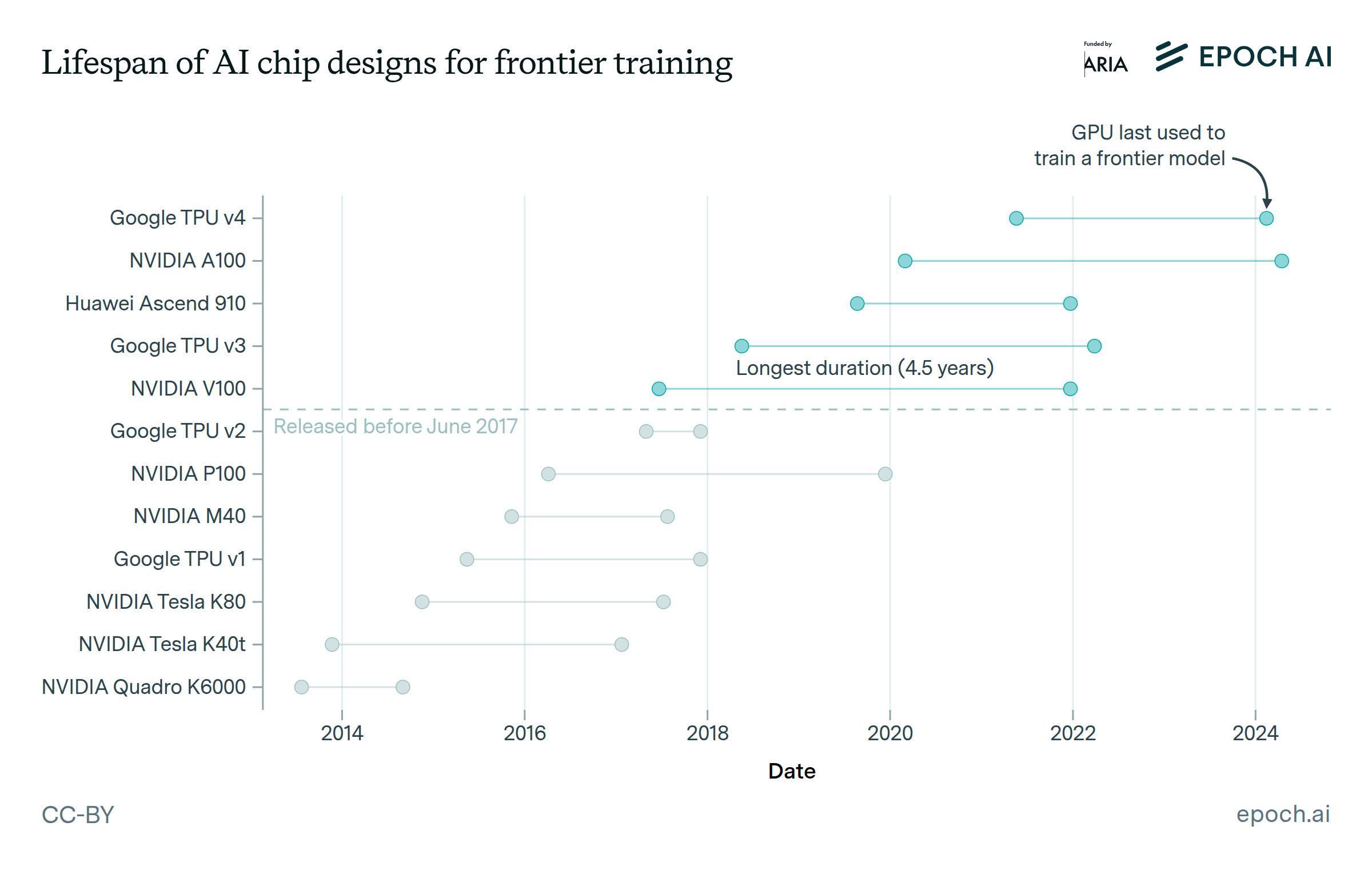
Before our main analysis, we exclude any AI chip design that has been used to train a frontier model published within the last 7 months, because these chip designs may still be used in future frontier training runs. We chose this 7-month threshold because it corresponds to the 95th percentile interval observed between successive frontier training runs on the same chip design, among chips at least as new as the NVIDIA V100. In other words, historical data suggests that if no frontier model has been trained on a chip for at least 7 months, it is unlikely the chip will be used again for frontier training.
We focus primarily on modern AI chip designs (NVIDIA V100 and newer), because these chips mark a shift towards large-scale industrial AI training runs. Prior to the introduction of NVIDIA’s V100, frontier AI training was spread across a wider variety of chip designs; pre-V100 chip designs trained an average of only 2.1 frontier models each, compared to an average of 9.3 frontier models per chip among V100 and newer designs. This latter paradigm is more relevant for characterizing current and future frontier training runs.
Among the 5 AI chip designs that are at least as new as the NVIDIA V100, the median lifespan from release until final use for frontier training is 3.9 years. For these newer chip designs, lifespans range from 2.3 to 4.5 years. In contrast, older AI chip designs generally saw shorter lifespans. The 7 chip designs released prior to the NVIDIA V100 have a median frontier lifespan of 2.6 years, with individual lifespans ranging from 0.6 to 3.7 years. Considering all chip designs at once, the median frontier lifespan is 2.7 years.
We also calculate the lifespan of AI chip designs when considering all models in the Notable Models dataset, rather than only frontier AI models. The Notable Models documentation explains how we define a notable model. We follow the same filtering process as for frontier AI models, finding that the 95th percentile for the length of time between notable model training runs for a given AI chip design is 6 months. Removing AI chip designs which were seen training a notable model published within the last 6 months, we are left with 17 AI chip designs used to train notable models in our dataset. Looking at the 9 chip designs beginning with the NVIDIA V100, the range of durations between initial release and final use spans 0.3 to 6.5 years, with a median of 2.1 years. Note that the median is lower than in the case of the frontier models, since non-frontier models are trained with a wider variety of chips; most of the chips that were unseen among frontier models are significantly less popular, and consequently tend to have shorter lifespans.
Finally, note that our endpoints are defined by the publication date of the last known model trained using each chip. In practice, there is often a delay of weeks or months between the completion of training and a model’s public announcement. Our results are thus a weak upper bound on the duration between AI chip release and completion of the final frontier (or notable) training run.